

A clear juice enquiry often comes back quoted as a puree line with a filter added later. The choice refers to where the finished product sits: clear juice has to be bright, free of suspended solids and stable in storage, while puree keeps the fruit body and mouthfeel. That choice is made before the quotation, and it decides how many process stages the line actually needs.
What separates clear juice from puree?
Clear juice is juice whose pectin, protein and suspended particles have been removed, bright enough to read high on transmittance and stable for months. Take apple clear juice: wash, sort, crush, press, then choose enzyme treatment and clarification against the specification; ultrafiltration is one optional route. Puree takes the other road, milled fine and held in suspension, so the two part company right after pre-treatment.
|
First choose the form |
Then decide on concentration |
Key stages |
|---|---|---|
|
Clear juice |
bright, no sediment; sold single-strength or as concentrate |
crush, press, enzyme treatment, rough filter; ultrafiltration optional |
|
Cloudy juice or puree |
fruit body in suspension, sold on texture |
pulping, homogenisation, deaeration, sterilization |
Concentration follows the sales route: clear juice can be sold as-is or evaporated, and puree filled directly or concentrated for transport. An evaporator is not standard on every clear juice line.
Where does ultrafiltration sit in the line?
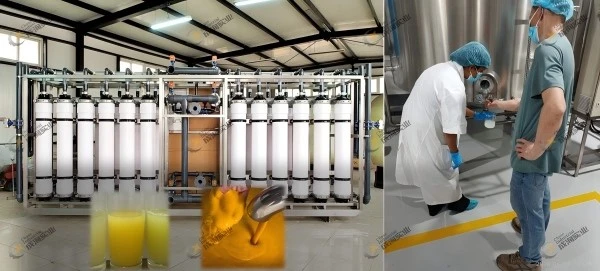
Ultrafiltration sits after enzyme treatment and before evaporation, holding back pectin, protein and large polyphenols while sugars, acids and aroma pass through. It needs a rough filter ahead of it and sterilization behind it; an evaporator follows only where the product is sold as concentrate. Move it one step and the stages on both sides have to be reconfigured.
Membrane pore size generally falls between 0.01 and 0.1 micron, following what has to be retained. Tighter means brighter juice but faster flux loss; looser leaves haze that returns during shelf life. The right grade is the one that matches the finished specification.
What does coarse pre-treatment cost you later?
Whatever is saved in pre-treatment comes back as membrane replacement. Uneven crush size and a rough filter that lets fibre through put solids straight onto the membrane surface: flux falls, cleaning intervals shorten, and the elements are eventually written off. The rough filter exists to protect the membrane, and piping with low pockets or dead ends carries debris to the same place.
Can ultrafiltration work without proper enzyme treatment?
Without complete enzyme treatment the pectin stays in the juice, viscosity stays high, and the membrane skins over with a gel layer that no amount of membrane area will fix. Common industrial conditions run at 45 to 55 °C for 45 to 80 minutes, adjusted for ripeness and pectin content. The enzyme tank has to hold temperature and agitate, and the dose is set by trial on the actual fruit rather than by a fixed figure.
Can the evaporator be shared with a puree line?
Whether the evaporator can be shared is settled by comparing the two materials: viscosity, particle content, throughput, heat sensitivity and cleaning changeover, with the target concentration one input among several. Pectin in an evaporator scales the tubes faster, so a shared line needs a written changeover plan: how the piping drains, which cleaning circuit runs, and how the two products are kept apart. Concentrate endpoints commonly land between 65 and 72 Brix, one selection input among material properties and the heat window; clear juice is sensitive enough that the last effect has to be held tighter.
When is ultrafiltration the wrong choice?
Not every clear juice project needs the membrane stage. Products built on fruit body lose their selling point once the body is filtered out, and cloudy juice does not need the stage at all. Small output is the other case: every membrane cleaning is a stop, and on a line running a few tonnes a shift the cleaning time can outlast production. Low-pectin raw material sold locally on a short shelf life can rely on good rough filtration and centrifugation instead.
What should be settled before the quotation is compared?
|
Question |
Why it matters |
|---|---|
|
Is enzyme treatment inside the scope |
If not, the tank you add has to hold temperature and agitate, or the membrane cannot perform |
|
What output the membrane area is sized for |
Too little area caps the peak season, too much raises cleaning water and downtime |
|
Shared or separate evaporator |
Sharing needs a changeover and cleaning plan, separation changes investment and floor space |
|
Sterilization and filling matched to clear juice |
Clear juice is more heat-sensitive, so intensity and pack format change with the route |
Order of work: fix the product form, decide on enzyme treatment and ultrafiltration, confirm evaporation and filling, then check the quotation against those four questions. The route is settled first, which makes two equipment lists comparable at all.