

Screen opening is often treated as finished-product fineness. In practice, pulp contains flesh, fiber, skin, and sometimes stone fragments. Screen size is only one separation condition; rotor speed, beater condition, feed uniformity, and fruit maturity also change the result. The first stage normally performs coarse pulping or separation after destoning. The second stage then controls fiber and particle size. If both stages are asked to do the same work, a fine screen may receive excessive load and cause blockage, poor residue discharge, and lower usable capacity.
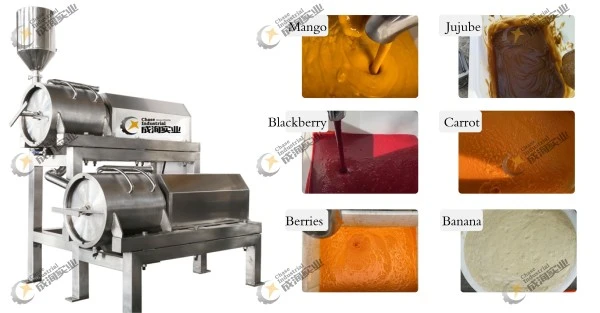
Screen size does not define texture by itself
The equipment handles mangoes, peaches, apricots, guava, and other fruit requiring destoning, pulping, or refining. Changes in temperature, viscosity, particle load, gas content, or incoming material can shift its operating point. A nominal rating describes the equipment, but does not prove the result with the production material.
Reducing the opening may improve apparent fineness while increasing pressure, blockage, product loss, and cleaning frequency. Confusing fresh-fruit input with finished-pulp output creates a second capacity error. A sound comparison includes product quality, stable run time, product loss, maintenance, and cleaning frequency.
Each pulping stage needs a different separation duty
The inlet must match the crushing or destoning condition, while the outlet must suit pumping, buffering, preheating, sterilization, and filling. A screen change can alter particle load and viscosity, so downstream pumps, heat exchangers, and cleaning circuits need review. Mechanical connections, product conditions, controls, and sanitation affect the same operating section and need to work under the same production sequence.
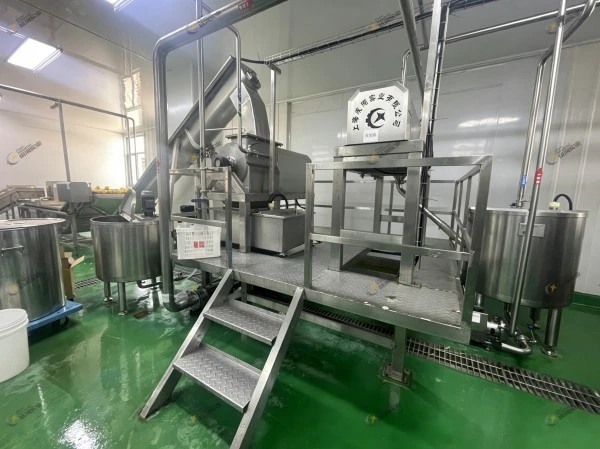
Residue and stable throughput matter alongside fineness
A useful trial records flesh remaining on stones, pulp lost with residue, perceived fiber, screen blockage, continuous run time, temperature rise, and actual pulp flow. Fineness alone does not show the full separation result. Linking these observations to the material batch, equipment settings, and cleaning state helps separate raw-material variation from wear, hydraulic resistance, and line-timing problems.
During production, record mangoes, peaches, apricots, guava, and other fruit requiring destoning, pulping, or refining together with the inlet condition, operating settings, downstream status, and cleaning state. Compare later batches with the same set of observations. In a multi-product line, keep a separate operating record for each product and package.
Run mangoes, peaches, apricots, guava, and other fruit requiring destoning, pulping, or refining long enough to see stable production, normal stopping, restart behavior, product changeover where relevant, and recovery after cleaning. These points often reveal restrictions that do not appear during the first minutes after start-up.
Define whether the output is puree, pulp, a beverage base, or a product with retained particles. Representative fruit can then be used to test the duty of each stage, screen combination, speed, residue discharge, and stable operation. Use these conditions to size the equipment, arrange interfaces, and set the operating sequence.
Compare pulp and residue during the same fruit trial
During a fruit trial, weigh feed, finished pulp, and residue, and record stable flow, blockage, temperature rise, and pulp texture. Use the combined result to compare screen arrangements.
During each shift, compare start-up, stable running, normal stopping, and restart with mangoes, peaches, apricots, guava, and other fruit requiring destoning, pulping, or refining. Record changes when upstream feed or downstream demand moves away from steady state. Use those observations to adjust feed rate, level control, line pressure, cleaning timing, and operator settings. Keep the same record after maintenance or product changeover so the next team can see what actually changed in production. Review the complete record before the next run.
Shanghai Chase can configure the why a finer screen is not always better in a double-stage pulper process around the product, production schedule, connected equipment, cleaning route, and factory utilities.