

Coconut projects are rarely bought in one pass. Water comes first, milk or cream once the market proves out, as many projects in Vietnam do. The risk is phase one being sized for water alone: when phase two arrives there is no route after the water is drawn, no floor for grinding, and no place for blending. A missed fork point turns expansion into half a new line.
Where do the two products split?
The front end is not one fixed sequence. Young nuts are opened for water. For mature nuts, water may be drawn first, or collected as the nut is opened; the kernel is then recovered and pared and washed as the product requires.
One stretch before extraction can be shared, but its layout follows the raw material. With mature nuts, water is drawn first and the kernel goes straight to grinding and pressing in the same pass, so the batch crosses the front end once. Where the phases run different nuts, two intake routes run side by side, sharing only washing, conveying, CIP and utilities. The split comes at extraction: water to filtration and centrifuge clarification, milk to grinding, pressing and de-oiling. The fork point refers to that junction.
|
Step |
Coconut water line |
Coconut milk line |
|---|---|---|
|
Raw material and use |
young nuts, water is the product |
mature nuts, kernel is the product |
|
Opening and kernel recovery |
open, collect water in a closed line |
water drawn first or collected at opening; kernel recovered next, then pared and washed as the product requires |
|
Filtration and centrifuge |
two-stage filter and disc centrifuge |
centrifuge for de-oiling and fat separation, a different duty |
|
Extraction |
none |
grinding and pressing, often two to three stages |
|
Standardization |
generally not needed |
set fat and total solids to the customer spec |
|
Homogenization |
not needed |
needed to hold the emulsion |
|
Sterilization and filling |
tubular UHT plus aseptic filling |
heating form follows viscosity; aseptic bulk is common |
Lay this table over the drawing: which sections are bought twice, and which one is sized against the peak of both phases.
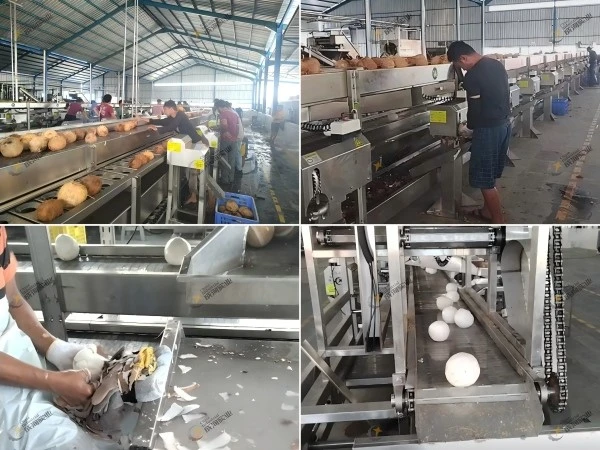
What can be shared, and on what terms?
Three inputs set shared capacity: peak intake per phase, whether both run at once, and whether the raw material is the same. A batch drawn for water and then pressed for milk crosses once; separate routes, or parallel phases, are where peaks add up. Adding annual tonnage and calling it equipment capacity is the usual mistake. On an assumed 2 t/h young-nut line plus 1.5 t/h mature nuts in parallel, receiving and washing are sized for both peaks.
Where washing and conveying are shared, CIP alkali and acid circuits must switch by product, and coconut fat residue cleans harder than coconut water; cross-contamination surfaces here first.
Not every section is worth sharing. Grinding, pressing and standardization are the core of the milk line; squeezing them into phase one floors limits phase two. Reserve space, tie-ins and utility headroom, then install those sections separately.
Sequencing phase two
Front end once, extraction in stages. The front end is sized against both phases' peak intake and raw material route, without double counting a batch that yields water and milk in one pass; extraction, blending and homogenization arrive in phase two. Reserved tie-ins let the new sections connect without rebuilding.
How does a fat spec become equipment?
Fat and total solids are set by the target market standard and the customer's product specification. The Codex standard for aqueous coconut products sets a minimum fat for each and also sets total solids, so one range cannot define the category. Bands such as 17% to 22% or 24% to 28% are order examples, confirmed against the customer spec.
This lands on blending: first-press extract runs high and is trimmed with water or second press, and the scope states tank volume, agitation and inline measurement of fat and total solids with batch records.
Sterilization needs validation on the product. Common UHT conditions sit at 135 to 145 °C for 2 to 5 seconds, but viscosity, particles, pH and pack format move the window, and cream differs from water.
Four questions before comparing quotations
|
Question |
Why it matters |
|---|---|
|
What the front end is sized against |
peak intake, parallel operation and raw material, not annual tonnage added up |
|
What phase two tie-ins are reserved |
pipe tees, valve positions, floor and utility headroom |
|
How shared sections change over and clean |
fat residue is where cross-contamination shows first |
|
How fat and total solids are measured |
inline plus batch records is the audit-ready setup |
Order of work: fix the route and split diagram, settle the sharing boundary, size against both peaks, then match fat and total solids to the customer spec. Get the fork point right and phase two adds sections.