

Crushing, pulping, pumping, and mixing can bring air into juice. Some remains as visible bubbles, while some dissolves in the liquid. Oxygen can accelerate polyphenol oxidation and ascorbic acid degradation, so the juice darkens faster. Bubbles may also disturb pump delivery, heat-exchanger feeding, filling level, and package appearance. Vacuum deaeration lowers the gas-phase pressure so that gas can leave the product and be removed by the vacuum system. Product temperature, viscosity, incoming gas load, vacuum conditions, residence time, and mass-transfer behavior all affect the result.

Foam and dissolved gas are different observations
The equipment handles free bubbles and part of the dissolved gas carried by juice, puree, or a formulated beverage. Temperature, viscosity, particle load, and incoming material can change how it runs. Nominal capacity alone does not describe production performance.
Selecting from vacuum level or nominal capacity alone ignores product behavior and line timing. Deaeration also cannot replace hygienic raw-material handling, validated thermal treatment, sealed filling, or correct storage. Compare product quality, stable run time, product loss, and cleaning frequency.
The deaerator depends on stable upstream and downstream conditions
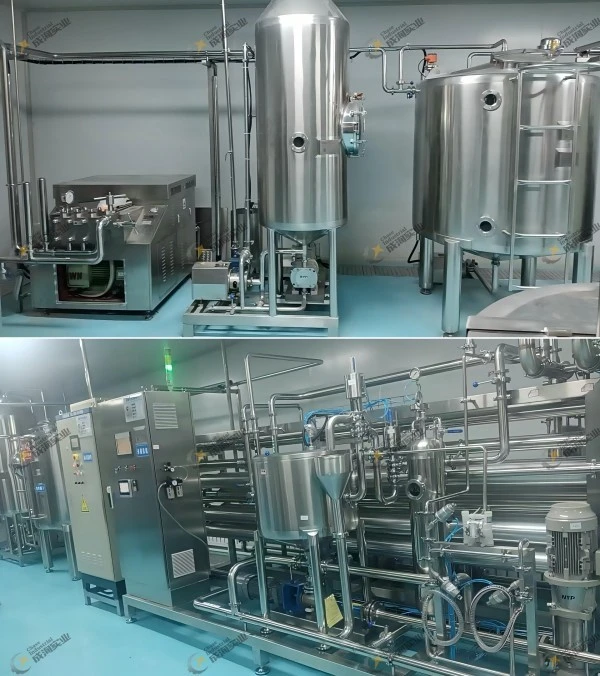
The deaerator needs a stable inlet and a defined outlet condition for homogenization, sterilization, buffering, or filling. Feed pumps, valves, level control, vacuum generation, condensate handling, and the CIP route form one process section. Connections, controls, and sanitation must follow the same production sequence.
Use filling and flow records to tune the operating point
Foam, unstable pump flow, irregular heat-exchanger feed, filling-level variation, residual package gas, and color or flavor change can justify investigation. None of these observations proves that deaeration is the only cause. Tie each observation to the batch, equipment settings, and cleaning state before changing the process.
For free bubbles and part of the dissolved gas carried by juice, puree, or a formulated beverage, keep a separate operating record for each product and package. Include the inlet condition, main settings, downstream status, and cleaning state.
Run free bubbles and part of the dissolved gas carried by juice, puree, or a formulated beverage long enough to observe stable production, a normal stop, restart, and recovery after cleaning. The first few minutes rarely show the full restriction.
Define the product, temperature, viscosity, incoming gas condition, observed symptoms, downstream equipment, permitted pressure, and operating pattern. Acceptance should measure the problem being solved rather than only the vacuum displayed by the machine. These conditions determine equipment size, interfaces, and operating sequence.
Follow the product through a full production run
Record inlet temperature, vacuum, level, inlet and outlet flow, foam, and filling behavior during a full production run, then tune vacuum, feed, and residence time from those observations.
With free bubbles and part of the dissolved gas carried by juice, puree, or a formulated beverage, compare start-up, stable running, stopping, and restart. Use the record to adjust feed, level, pressure, and cleaning timing, then repeat the check after maintenance or product changeover.
The final layout for free bubbles and part of the dissolved gas carried by juice, puree, or a formulated beverage must also define short stops, recirculation, cleaning, connected equipment, and factory utilities.