

A berry puree processing line should not be specified from the fruit name alone. Strawberries, blueberries, and similar materials differ in stems, skins, seeds, firmness, maturity, and oxidation behavior. The required output may be a textured puree, a smoother juice base, or an ingredient for later formulation. That choice determines how pretreatment, pulping, thermal processing, and packaging should connect.
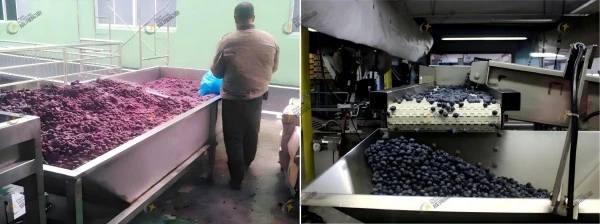
The receiving specification should state whether the fruit is fresh or frozen, how leaves and foreign matter are removed, how stable the maturity is, and how long the material may wait before processing. Soft berries can be damaged during conveying and washing. Incoming temperature and batch variation can therefore affect the front end before the pulper becomes the limiting step.
Match the berry process route to the target product
After washing, not every berry follows the same route. A puree with retained pulp requires decisions on crushing, pulping, screen size, and particle control. A clearer juice may require a different extraction and clarification interface. Whether seeds, skins, and fine fiber remain in the product changes pumping, heat transfer, filling, and mouthfeel.
A strawberry puree with visible pulp is not the same duty as a smooth blueberry base for later blending. The required texture determines how much skin, seed, and fine fiber may remain. That decision reaches the pulper screen, transfer pump, heat exchanger, filler valve, and the buyer's downstream use.
Review berry-line equipment through connected interfaces
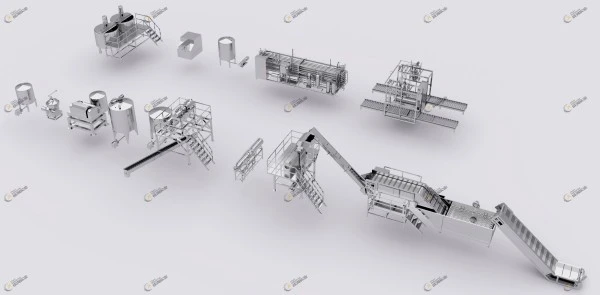
Pretreatment should limit unnecessary squeezing and product hold-up. Pulping and refining equipment must match the seed load and required texture. Downstream, viscosity, particles, acidity, and fouling tendency influence the heat exchanger, holding section, pumps, valves, and cleaning circuit. Aseptic projects also need a coordinated buffer and filling interface.
Fresh and frozen berries also need different receiving plans. Frozen fruit may require controlled thawing, while fresh soft fruit can lose quality through waiting, drops, or aggressive washing. The front end should control foreign matter and feed the pulping section without creating avoidable damage.
Changeover conditions determine whether sections can be shared
A frequent mistake is to configure screens, pumps, and thermal conditions for one berry and later assume that another berry can run without review. Similar product names do not prove line compatibility. Color and flavor carryover, seed size, viscosity, changeover time, packaging, and CIP/SIP requirements define which sections may actually be shared.
A line selected around strawberries may need different screens, pump settings, and cleaning time for blueberries. Seed dimensions, viscosity, color carryover, and aroma retention can change which sections are shared. The production calendar matters because one seasonal campaign is easier to manage than repeated short changeovers.
Thermal conditions and yield remain tied to the actual raw material and product specification. Samples, maturity, pulp target, package, storage plan, and operating hours are the appropriate basis for confirming those values.
Aseptic bag-in-drum, smaller industrial bags, or another bulk format can impose different filling cycles and product inlet conditions. The upstream thermal section and any aseptic buffer must be balanced against the selected package. Leaving packaging open until the end can produce a line that processes fruit correctly but cannot maintain a stable filling rhythm.
A practical berry-line compatibility check
A practical review uses one comparison table for each berry: receiving condition, seed and skin load, target texture, viscosity, thermal duty, package, and changeover time. Sections can remain common when the differences can be handled by verified screens, settings, and cleaning procedures. When pretreatment, thermal behavior, and packaging all diverge, those sections should be separated. Campaign length and daily changeover frequency should be included because they alter usable production time. Shanghai Chase uses this comparison to classify shared equipment, change parts, and fruit-specific modules.