

Fruit processors often face a seasonal utilization problem. A plant may receive apples for one campaign, pears several weeks later, and mangoes, peaches, apricots, pineapples, or passion fruit during other parts of the year. This naturally leads to one question: can one fruit processing line handle multiple fruits?
Yes, if multi-fruit operation is included in the engineering basis from the beginning. The practical objective is not to force every fruit through exactly the same machines. It is to share compatible process sections, use change parts where the differences are manageable, and install dedicated pretreatment modules where the raw material requires a different handling method.
This approach can extend the operating season and improve equipment utilization. It can also reduce duplicated tanks, thermal processing equipment, filling systems, cleaning circuits, and utilities. However, the value depends on product compatibility and the real changeover schedule. A line that can technically process several fruits may still be inconvenient if it loses too much time between short campaigns.
Start with the finished product
The fruit name alone does not define the line. Apple can become NFC juice, clarified juice, concentrate, or a blended beverage ingredient. Mango can become puree, concentrated puree, or an ingredient for later formulation. These outputs create different requirements for clarification, evaporation, viscosity, thermal treatment, holding, and packaging.
A multi-fruit project is easier to design when the expected outputs follow compatible routes. Apple and pear intended for juice can have useful process similarities. Mango, peach, and apricot intended for puree may share parts of destoning, pulping, refining, holding, sterilization, and filling. If one product is a clear juice and another is a high-viscosity puree, the downstream equipment must be checked more carefully.
Use dedicated modules for the real differences
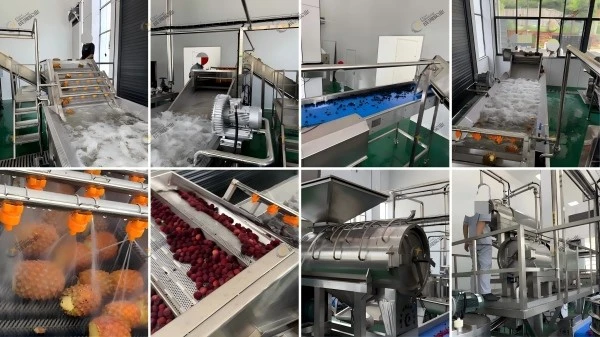
Pretreatment is where fruit differences are most visible. Apple and pear normally involve crushing and pressing. Mango, peach, and apricot require pit handling and pulping. Pineapple introduces peeling, coring, trimming, and a different extraction decision. Passion fruit requires shell opening, seed control, and attention to aroma retention.
A flexible line can address these differences with separate modules or appropriate change parts. After each fruit has reached a defined material condition, the process streams may connect to selected shared tanks, thermal processing equipment, aseptic fillers, packaging interfaces, or CIP/SIP circuits. This modular arrangement is more realistic than describing one universal front end as suitable for every fruit.
Confirm the operating range of shared equipment
Shared equipment must be suitable for the complete material range. Viscosity and particle size affect pumps, valves, pipe velocity, heat transfer, holding time, and filler selection. Fiber and pectin can affect screens and cleaning. Product color and aroma may remain in tanks or pipework after an ordinary rinse. Thermal treatment conditions may also differ between juice and puree.
The review therefore needs more than a statement that the machine can run. It should identify the permitted product range, required screens or change parts, operating adjustments, product-contact surfaces, cleaning route, and any limits around particles or viscosity. These points help the factory understand what can be switched by procedure and what requires dedicated equipment.
Production scheduling determines whether sharing is economical
Seasonal campaigns are usually more favorable for shared equipment than daily product changes. If the plant processes one fruit continuously for several weeks, the time used to change screens, redirect valves, complete CIP/SIP cleaning, and verify the next start-up is spread across a longer production run. With frequent short batches, the same changeover time can become a major part of the schedule.
Changeover also creates first and last product, cleaning water, inspection work, and possible product loss. These items should be included when comparing one flexible line with two more independent process sections. The lowest initial equipment count does not always produce the lowest operating cost.
Packaging can create a separate boundary
Bottled juice, pouches, BIB, 200 L bag-in-drum, IBC totes, and other aseptic bulk formats require different filling interfaces and operating rhythms. A project may share pretreatment and sterilization while using separate filling equipment. In another project, the aseptic filling system may be shared because the products and package formats remain within one validated operating range.
Holding capacity also needs attention. The pretreatment section may run in batches while sterilization and filling prefer a steady flow. Buffer tanks can help connect the sections, but their volume, residence time, agitation, sanitation, and cleaning must suit each product.
What information is needed before quotation?
For a multi-product fruit processing line inquiry, prepare the fruit list, target output for each fruit, expected harvest or production season, planned batch length, package format, changeover frequency, available plant layout, and utility conditions. Samples or reliable descriptions of viscosity, fiber, particles, and product specifications are useful when available.
Shanghai Chase can use these inputs to define shared equipment, interchangeable modules, dedicated pretreatment sections, cleaning routes, packaging interfaces, and the remaining technical questions. Capacity, utility demand, price, delivery scope, and performance conditions should then be confirmed against the selected process routes and operating schedule.
The result should be a line that is flexible for the fruits the factory actually plans to process, not a generic machine list that claims unlimited material compatibility. When product routes and changeover conditions are clear, one line can serve several fruit campaigns without turning every production switch into a new engineering problem.