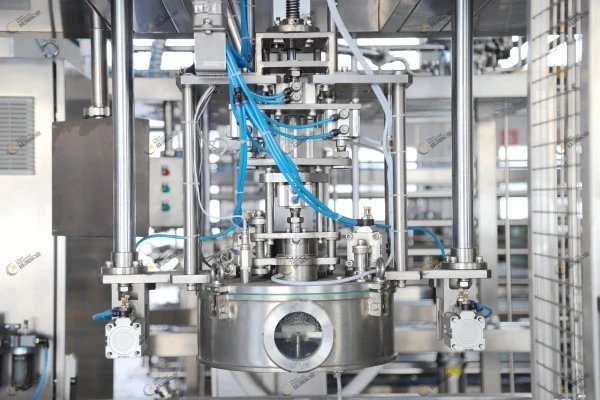
An aseptic line is defined by the section between the last sterile treatment and the sealed package, not by the sterilizer at the front of it. Everything the product touches inside that stretch has to hold the same condition.
What counts as an aseptic line?
A UHT unit controls the product only up to its own outlet, and everything after that point decides whether the line is aseptic at all. Cooling, buffering, transfer, filling and sealing all sit downstream, and losing sterility in any of them wastes the accuracy upstream.
Where does the sterilizer stop and the boundary start?
Marking the last sterile treatment gives you the starting point, and every contact surface from there to the seal sits inside the same boundary. Where that line is drawn decides how long a stop is allowed and how the line recovers.
Why does the aseptic buffer tank fail first?
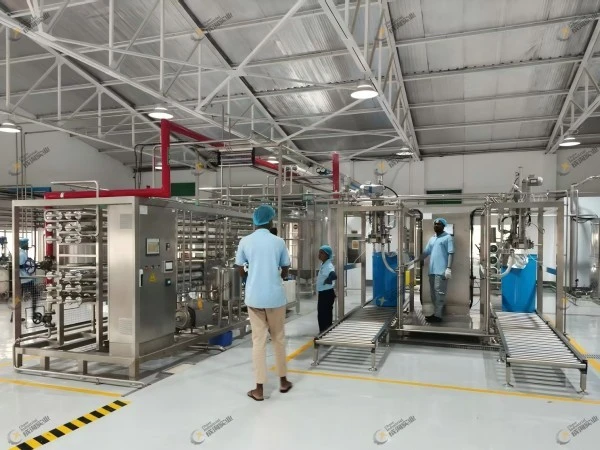
A continuous sterilizer feeds without interruption while a multi-head filler draws in bursts, so the aseptic tank between them has to absorb that difference. It also holds a slight positive pressure against outside air, and its level has to stay in range, both of which warn earlier than the temperature display. When a stop outlasts the buffer, the product takes a second heat load.
Which points on the boundary break first?
The boundary fails at seals, sampling ports and instrument connections far more often than it fails at the equipment body itself, and these are the first places to check. A valve seal that lets go connects the product side straight to the outside, and the piping has to drain completely, because low pockets hold product cleaning never reaches.
Package sterilization, filling valves and sealing
Package sterilization, filling valve behaviour and the filling environment are three separate controls, and each of them tends to fail in a different way. Packaging material is sterilized before it enters the filler, by a method matched to the material and the film speed, while a drift in sealing temperature or pressure shows up directly as swollen packs.
Where steam cannot reach, the line is not sterile
Steam coverage decides whether sterilization has been complete, and branches, blind ends and spare connections are the places where that coverage usually fails. Cleaning comes first: residue packed into a blind end does not come off with steam alone, so a caustic wash at 1-2% and 70-80 °C runs first.
How do you trace swollen packs?
Start with the distribution of failures rather than with the sterilizer, because the pattern narrows the search faster than any single measurement. Failures concentrated on one filling head point away from the sterilizer. Then sealing records, buffer pressure and level, then the sterilizer.
|
Point |
Hot-fill line |
Aseptic line |
|---|---|---|
|
Filling area |
controlled clean area |
positive-pressure aseptic area |
|
Packaging material |
sterilized after filling |
sterilized before the filler |
|
Storage |
cold chain |
ambient |
|
Failure pattern |
a few packs or one batch |
whole batch |
When is an aseptic line the wrong choice?
Not every product needs an aseptic line, and what decides is how far the product travels and what storage it can accept. A product sold locally, moving fast and kept in the cold chain pays for sterilization and validation without gaining much. Ambient aseptic packs carry 6 to 12 months of shelf life, and that holds only when the whole chain holds.