

Many buyers request an equipment list before the product boundary is clear. For a juice and puree concentration line, the first decision is more basic: Will the plant make NFC juice, standard puree, or a concentrated ingredient for storage and transport? The answer changes the process route, packaging interface, cleaning plan, and quotation scope.
Concentration changes more than water content. Viscosity, flavor retention, heat transfer, downstream packaging, and the cleaning boundary all affect the process design. This is why two factories processing similar fruit can require different tanks, pumps, heat exchangers, fillers, and cleaning circuits.
Shanghai Chase supplies industrial food processing equipment and fruit and vegetable processing lines, including UHT sterilization, aseptic filling, and project engineering support. A juice and puree concentration line is planned as a connected system rather than a collection of separate machines.
Suitable materials may include apple juice, pear juice, mango puree, tomato pulp, and tropical fruit puree. Their viscosity, fiber, particles, maturity, oxidation behavior, and storage temperature affect feeding, heat transfer, holding time, pumping, and cleaning. Samples or reliable material descriptions are useful when these properties vary by season or supplier.
The process route may include pretreatment, extraction or pulping, preheating, evaporation, holding, UHT sterilization, aseptic filling, and CIP/SIP cleaning. Pretreatment determines whether the downstream section receives a stable flow. Holding affects product quality and sanitation control. Sterilization and filling must match the product and package. CIP/SIP coverage affects daily operation, changeover time, and access to product-contact surfaces.
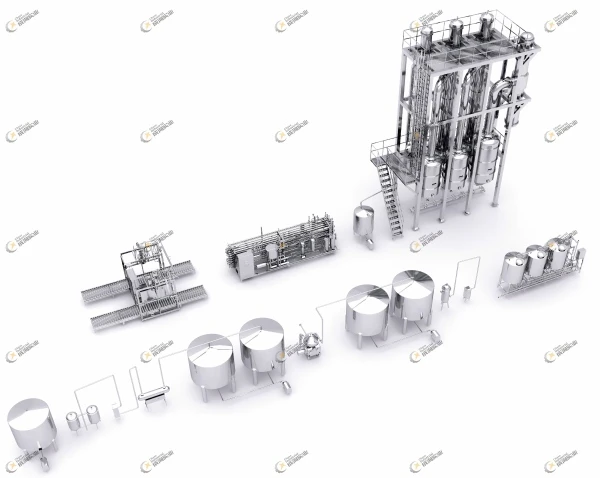
Product form is the next boundary. The same project may involve juice, puree, concentrate, products with particles, or bulk ingredients, but each form behaves differently during pumping, heating, holding, and filling. Selecting equipment before this point is clear often produces a quotation that looks complete but leaves important interfaces unresolved.
Packaging is part of the engineering decision. Options such as BIB, 200 L bag-in-drum, IBC totes, aseptic bags, and other industrial formats create different requirements for holding tanks, sterilization, filling interfaces, storage, logistics, and downstream use. Package size and filling method can also affect room layout, operator access, and cleaning arrangements.
Plant conditions matter before the layout is finalized. Available height, equipment access, drainage, steam, cooling water, compressed air, electrical supply, and cleaning space can change equipment positions and pipe routing. For an existing factory, current layout drawings and site photos are often enough to identify early constraints, even if detailed construction drawings are not ready.
Operating rhythm is just as important as nominal machine capacity. Incoming material may arrive in batches while sterilization and filling run continuously. Product changeovers may occupy hours that are missing from a simple capacity calculation. Buffer tanks can help, but they also introduce holding-time, sanitation, and product-loss questions.
Maintenance access also belongs in the early layout review. Screens, pumps, valves, heat exchangers, fillers, and product-contact pipelines need enough space for inspection and service. A compact drawing may save floor area but create avoidable work during cleaning or maintenance.
Waste and by-product handling can affect the same layout. Peels, seeds, fiber, spent pulp, and cleaning water need practical collection and discharge routes. When these routes cross clean operating areas or block access, routine production becomes harder even if the main process equipment performs as expected.
A complete process proposal separates known conditions from items that still require confirmation. Capacity, yield, shelf life, utility demand, cleaning time, delivery schedule, certification, and price depend on the raw material, target product, operating pattern, package, site, and acceptance method. Fixing these figures too early creates risk for both the factory and the equipment supplier.
When several suppliers are being compared, look beyond the length of the machine list. Check whether the proposal explains the connection between pretreatment, holding, sterilization, filling, packaging, and cleaning. Also check whether exclusions, site responsibilities, installation boundaries, and open technical questions are visible.
For a detailed juice concentration line inquiry, prepare raw material, target Brix range, product form, package format, storage and transport plan, plant utilities, and any downstream blending requirement. Product samples, package samples, an existing layout, and photos of the installation area can shorten the technical review when available.
With these inputs, Shanghai Chase can discuss the process route, equipment configuration, layout interfaces, installation and commissioning scope, and the information needed for the next engineering stage. The result is a project-specific basis for review, not a fixed promise built from an incomplete product name.