

Coconut water and tomato paste often come off the same type of line and fail in opposite ways. One goes yellow and loses its fresh, sweet taste; the other darkens, thickens and fouls the heating tubes within days. Both get blamed on the evaporator, when the real issue is usually the match between the product and the evaporator type.
What does evaporation actually do?
Evaporation refers to boiling water out of the product under vacuum and condensing it away, so solids rise and volume falls while flavour and colour are held.
Vacuum is what makes this gentle. At atmospheric pressure tomato juice only boils near 100℃, a temperature that drives off aroma and oxidises colour; under vacuum the boiling point drops to around 60℃, so the product is heated mildly and has a chance of keeping its character.
Why does viscosity decide the evaporator type?
The deciding factor is how thick the product is, and whether it can spread into an even film on the heated tube wall, since that single property decides which design will work and which will foul.
Read the symptom first, then the machine:
|
What you see |
Where it usually comes from |
What to check first |
|---|---|---|
|
Thin liquids turn yellow, taste flattens |
Heat exposure and residence time |
Is the unit hot with a long hold |
|
Thick products stall and foul |
Product viscosity versus evaporator type |
Falling film used on a high-viscosity stage |
|
Tubes foul and need washing in days |
Tube velocity |
Natural or forced circulation |
|
Solids drift up and down |
End-point control |
Inline Brix meter and sampling point |
|
Steam use far above plan |
Number of effects |
Effects fitted, vapour reused or not |
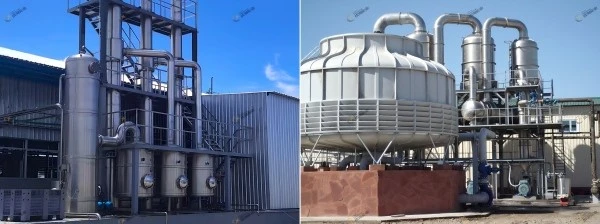
Thin, free-flowing products: falling film
A falling film evaporator refers to a design where the product flows down the inside of heated tubes as a thin film, spending only about two minutes in the heat.
Coconut water, clear juice and milk sit in this range: thin enough to spread evenly across the tube wall, with a short residence time that gives fresh taste and natural colour a chance to survive.
Thick, solids-bearing products: forced circulation
Pastes, jams and purees behave in the opposite way, because as they concentrate their viscosity climbs sharply, no even film can form, and whatever film does form scorches and fouls the tube wall.
Forced circulation uses a pump to drive the product through the tubes at high velocity, so it never sits long enough on the wall to burn. Tomato paste runs from 4.5% to 5.5% solids on the way in to 28% to 30% on the way out, and 36% to 38% for the higher grades.
How many effects, and where do you stop?
The number of effects decides how much steam you save, not whether the job can be done, because adding one effect lets the vapour from the last stage heat the next.
Two effects cut steam roughly in half against one; three save more but add complexity. The stopping point comes from the product: paste usually leaves at 28% to 30%, and higher grades at 36% to 38%. Reaching the figure reliably depends on inline Brix control rather than on watching the colour.
When is a multi-effect unit the wrong choice?
Not every project justifies multiple effects, and a line that switches products often, runs small batches and stops and starts will spend more time cleaning than it saves on steam.
Heat sensitivity matters too. More effects mean a lower final temperature, which suits coconut water, but when the product is not heat-sensitive and fouls easily, chasing extra effects only adds cleaning work. Viscosity, heat sensitivity and solids content decide the type first, and the effect count second.