

Pieces that arrive smaller and frayed, a pack that turns out cloudy instead of chunky, an exchanger that blocks within hours, a filler that drifts on weight. These are chased as four separate faults, yet they are one problem showing up at four points.
What does particle integrity mean?
Particle integrity refers to the share of pieces that still hold their original shape by the time the pack is sealed, and it is set by the whole line rather than by one machine.
It behaves like a shared budget: the pulper spends the first part, transfer and heat exchange spend more, and the filling port takes the last share.

Which stage should you check first?
Reading the symptom usually narrows the fault faster than naming any single machine, because each stage leaves its own mark on the pieces. Uniformly smaller pieces point to pulping, a mix of whole and pulped pieces to transfer, a fast-blocking exchanger to heat exchange, and drifting fill weight to the filling port.
|
What you see |
Where it usually comes from |
What to check first |
|---|---|---|
|
Pieces smaller and frayed |
Pulping and depitting |
Screen aperture against rotor speed |
|
Pieces turned to pulp |
Transfer pump |
Impeller type and running speed |
|
Flattened pieces, hard cores |
Pipe restrictions |
Elbows, valves and reducer count |
|
Exchanger blocking in hours |
Heat exchange |
Gap size against piece size |
|
Fill weight drifting, port holding pieces |
Filling port |
Port size against piece size |
|
Same recipe, different batch |
Cleaning and residue |
Screens, blind ends, valve seats |
Where are the pieces lost?
Four points along the line do most of the damage, and two of them are rarely on the checklist reviewed during commissioning.
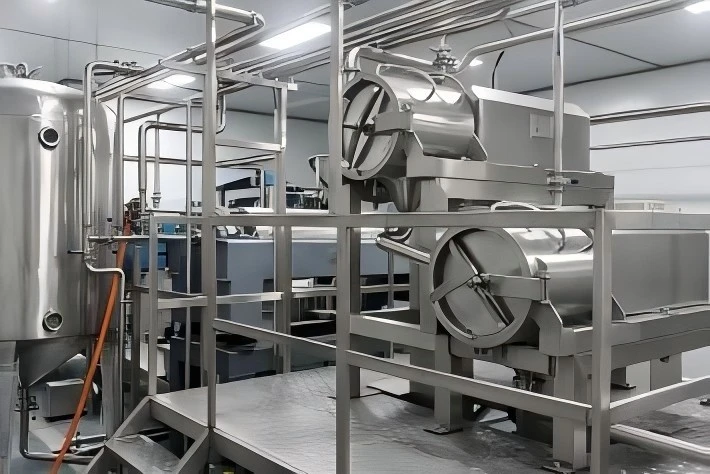
Pulping and depitting set the first limit. Screen aperture fixes how small a piece can become, and rotor speed decides how often it is cut inside the machine. Transfer, heat exchange and filling follow downstream, and none of them sits next to the pulper.
Why do pumps damage pieces?
A pump damages pieces because its impeller turns at speed and strikes them repeatedly, and the softer the fruit, the larger the loss at this stage.
The real problem in the piping is not the straight run but the restrictions: valves, elbows and reducers. The higher the velocity through them, the harder the pieces are hit, so a simpler route usually keeps more of them whole.
Can a tubular exchanger handle pieces?
A tubular exchanger transfers heat across a fixed gap, so once the pieces approach the size of that gap they are squeezed or blocked, and the selection differs from a clear juice line.
Clear juice carries no solids, which makes a narrow passage an advantage. Products with pieces of 3 to 5 mm need a different answer, usually a scraped-surface or agitated jacket design, where the product keeps moving across the heat transfer surface instead of being forced through a narrow channel.
What does the filling port cost?
The filling port is the last narrow opening the pieces pass, and it decides both how much product goes in and how much residue stays on the seat.
A port smaller than the pieces holds them back, and the residue on the seat then disturbs the next filling cycle. The piece size the product requires should therefore be fixed before the valve is specified, not after the machine arrives.
Which order should the decisions take?
Decisions should run backwards from the finished product, starting with the piece size the market expects and ending with the filling port.
The finished form is hard to move later, and it follows from the pack format and how the product is sold. A retail jar needs pieces that can be seen and bitten; an industrial drum or an aseptic bag is usually judged on viscosity and solids instead.
Why is cleaning harder than on a clear juice line?
Pieces lodge in screens, blind ends and valve seats in a way that clear juice never does, and the residue left behind also changes how the next batch behaves.
The usual sequence is a caustic circulation at 1-2% and 70-80 °C to soften fruit and sugar residue, followed by hot water or steam. The limit is coverage: a dead corner packed with pieces is not reached by circulation at all, so it has to be opened and checked.
When is holding the pieces the wrong goal?
Not every jam benefits from whole pieces, and a spread or a fine puree is better served by smoothness and repeatability than by visible fruit.
What decides is how the product is used. A filling or a spread is judged on how evenly it coats, not on how many pieces can be counted. Products that do need the pieces are the ones where visible fruit is part of the offer itself.